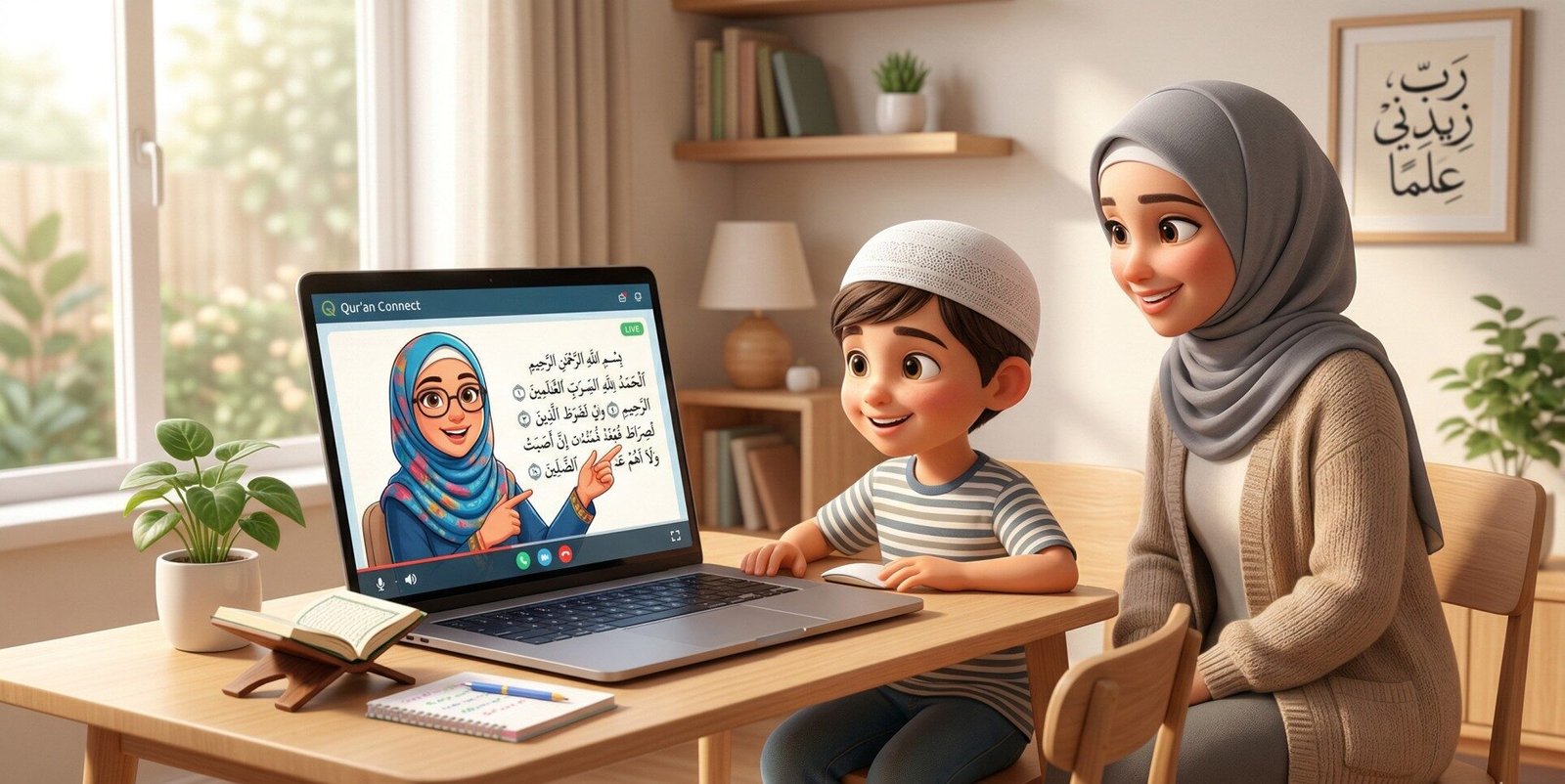

How to Teach Quran to Kids Step by Step
Every Muslim mother carries the same dream in her heart — to one day sit beside her child and hear them recite the Quran beautifully. To watch them grow up connected to Allah’s words. To know that no matter what the world throws at them, they carry the Book inside them. That dream is real. And it is entirely within your reach.
But if you are reading this right now, you are probably also feeling something else. Overwhelmed. Unsure where to begin. Maybe your child is already four or five years old and you feel like you have already fallen behind. Maybe you are asking yourself: Am I even qualified to teach this? What if I do it wrong? Where do I start?
What Age Is Your Child? Start Here
The first question to ask is not how to start — it is where to start based on your child’s age. The approach for a three-year-old is completely different from the approach for a nine-year-old. Here is a quick map.
| Age Band | What to Focus On | Session Length |
|---|---|---|
| 3 – 5 years | Listening and love only. No formal lessons yet. Play Quran audio in daily routines. | 5 minutes or less |
| 6 – 8 years | Introduce Noorani Qaida and begin memorising short surahs from Juz Amma. | 10 – 15 minutes |
| 9 – 10 years | Build reading fluency, introduce Tajweed rules, and begin exploring meaning. | 15 – 20 minutes |
What if my child is already 9 or 10 and has not started yet?
First: breathe. It is not too late. Many children who begin Quran at 8, 9, or even 10 years old go on to become strong reciters. The brain is still highly receptive at this age, and with the right approach and consistency, your child can absolutely catch up. The only mistake is continuing to wait.
Are You Qualified to Teach Your Child Quran?
This is the question most parents are too afraid to ask out loud. Let us answer it honestly — for both situations.
“I cannot read Arabic fluently”
- You do not need to be a hafiz
- You do not need a certificate
- Use the right tools + be consistent
- Learn alongside your child
Children whose parents learn with them often develop a stronger love for the Quran.
“I can read — give me the exact plan”
- Correct pronunciation in real time
- Introduce Tajweed rules gradually
- Set clear weekly milestones
- Run a daily revision system
Follow the steps below closely and introduce one new Tajweed rule per two weeks.
Quick preparation checklist (for all parents)
Before your first session, make sure you have:
- Noorani Qaida — a book or app that teaches Arabic letters from scratch
- A Quran app with audio recitation — use a qualified sheikh as the pronunciation model
- A simple weekly tracker — a printed sheet or notebook to log each session
- 15 minutes of your day — consistent and protected, that is all you need
How to Teach Quran to Kids Step by Step
Follow these seven steps in order. Do not skip ahead. Each one builds the foundation for the next.
Before your child reads a single letter, let them listen. This is the most underused and most powerful step — and almost every parent skips it in a rush to begin formal lessons. Do not make that mistake.
For the first one to two weeks, simply play Quran audio during daily routines — breakfast, the car, bedtime. The goal is not memorisation, it is familiarity. You want the sound of Quran to feel like home, not something foreign and difficult.
Noorani Qaida is a structured Arabic alphabet learning system designed to teach children to read Quranic Arabic correctly from the very beginning. Think of it as the phonics stage of Quran learning — just as a child cannot read sentences before knowing the alphabet, a child cannot read Quran correctly before completing Qaida.
Skipping this step is the single most common mistake parents make, and it leads to years of incorrect pronunciation that becomes very difficult to fix later.
- Arabic letters in isolation — recognising and pronouncing each letter correctly
- Letters with harakat (short vowels — fatha, kasra, damma)
- Letter joining — how letters connect to form words
- Tanween, sukoon, and shadda — essential accent marks
- Basic Madd letters — the long vowel sounds
Do not rush through Qaida. A child who completes it properly will read Quran correctly for life. A child who skips it will struggle with every surah they try to memorise.
Tajweed — the rules governing correct Quran recitation — sounds intimidating. It does not need to be. You do not need to memorise a rulebook or use technical terminology. At this stage, Tajweed is simply taught through modelling and repetition.
The method is simple: play the correct audio, your child listens, then your child repeats. You say: “Say it like this” — and you demonstrate the sound. That is it.
Three basics to introduce gently:
- Madd (elongation) — when certain letters are held longer. Say: ‘This letter stretches like a long note in a song.’
- Ghunna (nasalisation) — the nasal hum on Noon and Meem. Say: ‘This sound comes from your nose.’
- Waqf (stopping) — where to pause at the end of a verse. Simply pause clearly yourself and your child will follow.
Consistency is the entire game. Five minutes every single day will produce far better results than one hour once a week. This is how memory works — the brain builds pathways through repetition over time, not through marathon cramming sessions.
The repeat-after-me method:
- Play one verse or one line from the audio reciter
- Pause the audio
- Your child repeats the line back — ideally three times
- Move to the next line only when the previous one sounds correct
- At the end, recite the entire passage together from the beginning
Once your child can recite clearly, begin memorisation. Always start from the back of Juz Amma — Surah An-Nas first, then Al-Falaq, Al-Ikhlas, and onwards. This is strategy: the shortest surahs come first, which means your child experiences completing something early. That feeling of accomplishment is the fuel that keeps them going.
Daily memorisation routine:
- Day 1 — Listen to the full surah three times, then repeat verse by verse
- Day 2 — Recite yesterday’s portion, then add the next verse
- Day 3 onwards — Daily revision of the full surah plus new verses
- Completion day — Recite fully without audio. Celebrate together.
Memorisation without meaning produces a child who can recite but does not feel connected to what they are reciting. Once your child has memorised a surah, spend one session simply talking about what it means.
Not a formal tafseer lecture — a conversation. For example, after memorising Surah Al-Ikhlas: “This surah is Allah describing Himself to us. He is One. He was not born and has no children. There is nothing in the universe like Him. Every time you recite this, you are speaking directly to Allah.”
That kind of brief, personal, age-appropriate conversation transforms recitation into relationship. And a child who feels a relationship with the Quran will carry it their entire life.
Children thrive on visible progress. A simple tracker — a chart on the wall, a sticker for each completed lesson, a surah completion board — does more for motivation than any lecture about the importance of Quran.
Print a weekly schedule, stick it somewhere visible, and let your child put their own stickers on it. Watch what happens to their commitment.
The Prophet (peace be upon him) said:
“The best of you are those who learn the Quran and teach it.”
— Sahih al-Bukhari 5027
Common Mistakes Muslim Parents Make — And How to Avoid Them
These four mistakes undo the work of even the most dedicated parents — and all of them are avoidable.
Never use Quran as a punishment or frame it as something your child must do or face consequences. This creates a deep negative association that can last into adulthood. Position it always as a gift and a privilege. Children who are afraid of their Quran time disengage. Children who love it come running.
Sporadic teaching is the number one killer of Quran progress. A parent who teaches intensively for two weeks, then misses a week, then restarts, will find their child forgetting almost everything and losing motivation entirely. Five minutes every day will take your child further than any catch-up effort.
Rushing from listening straight into Quran recitation without completing Qaida is the equivalent of asking a child to read novels before they know the alphabet. Pronunciation errors formed now become harder to fix every year. Qaida is not optional — it is the foundation everything else stands on.
There is no perfect age to begin. A child who hears Quran from infancy enters formal learning with a completely different relationship to the text. You can begin today, at whatever age your child is. The best time to start was yesterday. The second best time is now.
How a Quran Tutor Can Support Your Plan
Everything in this guide helps you build the foundation at home. But there comes a point where a qualified teacher takes your child to a level you simply cannot reach alone. Knowing when that point is — and how to find the right teacher — is part of the plan.