
How to Make Kids
Love the Quran
— 7 Proven Ways
A practical, heart-centered guide for every Muslim mother who was forced to learn — and refuses to pass that pain to her child.
How to make kids love the Quran: The most effective way is to build emotional connection before any memorisation begins. Play Quran softly at home, connect verses to your child's interests, and model a joyful relationship with the Book yourself.
Most articles tell you how to teach the Quran. This one is different. This is about how to make your child fall in love with it — so the Quran becomes something they return to, not something they escape from.
And it starts with understanding something important: you cannot give your child a love you haven't yet rebuilt in yourself.
- Way 1: Make Quran the soundtrack of your home — play it softly during meals, mornings, car rides
- Way 2: Connect Quran verses to your child's personal dream (doctor, pilot, artist)
- Way 3: Heal your own Quran relationship first — children absorb what you feel
- Way 4: Tell Quran stories as bedtime stories before introducing lessons
- Way 5: Let your child choose their favourite reciter — ownership builds love
- Way 6: Celebrate every small win loudly — one word, one surah, one question
- Way 7: Find a love-first, Al-Azhar certified Quran teacher for kids online

Why Muslim Mothers Raising Kids
in the West Face a Unique Challenge
Making Their Children Love Quran
You remember that feeling. The cold wooden desk. The ruler. The word you mispronounced — again. The tears you weren't allowed to cry. And the one emotion that grew stronger with every session: dread.
"I memorised every letter. But somewhere in that process, I lost every feeling. The Quran stopped being Allah's words to me — and became a test I was always failing."
If this is your story — even a part of it — then you are not alone. Millions of Muslim mothers raised in Egypt, Pakistan, Bangladesh, Somalia, and across the Muslim world carry this wound quietly. They learned the Quran through fear. And now they are raising children in the USA, UK, Canada, and Australia — and they are terrified of passing that fear on.
The beautiful truth? Your awareness of this wound is already the first step toward healing it — for you, and for your child.
- 01Why Western Muslim Mothers Struggle Most
- 02The Sheikh's Story — The Master Lesson on Love
- 03Allah is Al-Wadud — The Most Loving
- 04Amina's Story — From Tears to "Can We Read?"
- 057 Proven Ways to Make Kids Love Quran
- 06Do's & Don'ts — The Clear Guide
- 07What Changes When Love Comes First
- 08People Also Ask (FAQ)
Why Muslim Children in the West
Struggle to Love the Quran
The biggest challenge Muslim families face in the USA, UK, and Canada is not a lack of effort — it is a clash of environments. Children in Western countries are surrounded by a secular culture where the Quran can quickly feel like an obligation imposed by parents, not a gift offered by Allah.
Muslim mothers based in the following countries share a specific struggle: their children are surrounded by a secular culture where Islamic identity is constantly tested — and where the Quran can quickly feel like an obligation imposed by parents, not a gift offered by Allah.
In these countries, Muslim mothers consistently report the same challenges: children who prefer screens over the Mushaf, who feel embarrassed about being Muslim at school, and who resist Quran time because it feels like extra homework after an already long day.
The Most Important Insight for Western Muslim Mothers
Your child does not need to grow up in a Muslim-majority country to love the Quran. They need a home where the Quran is present, peaceful, and personal — not pressured. And that home? It starts with you.

The Sheikh Who Pulled
His Children From
Quran Class.
There is a story — passed quietly among Muslim families, whispered in parenting circles, shared in Islamic conferences — that has the power to completely transform how you approach Quran with your children.
A well-known Sheikh — a man of deep Islamic knowledge, a father who cherished the Quran above everything — discovered something disturbing one afternoon. He visited his children's Quran teacher unannounced. What he found was not a classroom of learning. It was a classroom of fear. The teacher was using punishment — shame, harshness, and pressure — to force his children to memorise.
That day, the Sheikh did something unexpected. He removed his children from the class immediately. His family was shocked. His community was confused. A Quran scholar — pulling his own children from Quran education?
He explained his decision with words that have echoed through generations:
"I would rather raise a child who loves the Quran without having memorised it, than raise a Hafidh whose heart holds no love for the Book of Allah."
— A Renowned Islamic Scholar, on why love must precede memorisation
Allah did not create the Quran to be a burden. He is Al-Wadud — the Most Loving, the Most Affectionate. His Book was sent as a mercy, a light, a companion. When we approach it with fear instead of love, we are unintentionally misrepresenting the very nature of the One who revealed it.
Teach your children who Allah truly is — and they will naturally want to read His words.
"From Tears to
'Mama, Can We Read Quran?'"
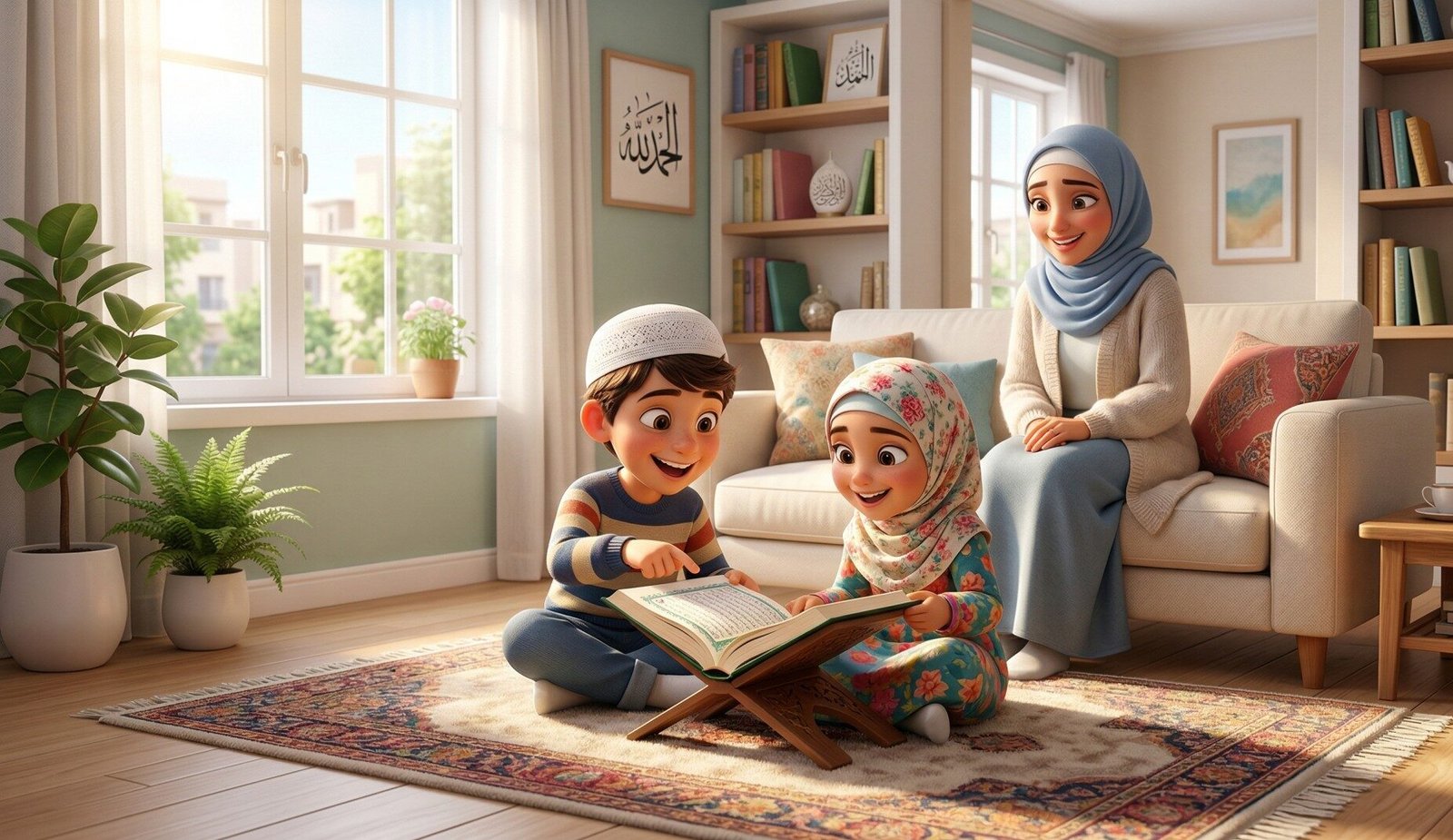
As a child, she was forced to memorize the Quran. Mistakes meant punishment. The Quran became associated with fear — not love. Not connection. Not Allah's mercy. Just the sound of a ruler, and the shame of making a mistake in front of everyone.
So when her 6-year-old son Yusuf began crying every time she opened the Mushaf… she froze. She recognized that cry. It was hers, from twenty years ago.
"I realized I was about to repeat the same story. And I couldn't. I wouldn't."
Instead of pushing him, she stopped completely for one week. No Quran sessions. No pressure. Just breathing room. Then — she changed everything.
Yusuf sat next to her quietly. Then he asked:
"Mama… what does this mean?"
Six Months Later
"Quran is no longer something he escapes from… it's something he returns to."
Because once the heart opens… everything else follows."
How to Make Kids Love Quran:
7 Strategies That Actually Work
These are not theories. They are the seven highest-impact strategies that Muslim mothers — across the USA, UK, Canada, and Australia — consistently report as the turning point in their children's relationship with the Quran.
Make Quran the Soundtrack of Your Home
Before any lesson, any reading, any memorisation — let the Quran simply exist in your home. Play it softly during breakfast. Let it play in the car. Put it on in the background during playtime. Children who grow up hearing the Quran absorb its sounds, its rhythms, and its feeling — without any pressure at all.
Connect the Quran to Your Child's Dream
Every child has a dream — a doctor, a pilot, an engineer, an artist. Your most powerful Quran teaching tool is showing your child that the Quran already knows their dream. Find the verses that speak to healing, to travel, to building, to beauty. Read them together. Watch your child's eyes change when they realize: "This is about me."
Heal Your Own Relationship First
Children do not inherit what you teach — they inherit what you live. If your child sees you dread the Quran, they will dread it. If they see you returning to it in moments of struggle, peace, and gratitude — they will too. Begin your own healing journey alongside theirs. Open the Quran for yourself, even if it's just one ayah a day.
Before any formal reading, bring the Quran alive through stories. The courage of Musa, the patience of Yusuf, the purity of Maryam — these are stories your child will beg to hear again. When they already love the characters, they will want to read their words.
Play Sheikh AbdulBasit Abdul Samed, Mishary Alafasy, and others — and let your child choose who moves their heart. When a child picks their own reciter, they own part of their Quran journey. Ownership is the beginning of love for Quran.
One new word recognised. One surah listened to all the way through without fidgeting. One curious question asked. These are massive victories — treat them that way. Positive reinforcement, not pressure, is what makes the Quran feel like a joyful achievement rather than a chore.
The right teacher changes everything. Look for an Al-Azhar certified online Quran teacher who builds a relationship with your child, celebrates their personality, and makes every session feel like a privilege — not a task. At Al-Rayaan Academy, our online Quran classes for kids are built entirely on this principle.
What Should Muslim Mothers
Do — and Not Do?
Based on Islamic scholarship, child psychology research, and the real experiences of Muslim mothers in Western countries, here is the clearest side-by-side guide:
| What TO Do | What NOT To Do |
|---|---|
✓ Play Quran softly in the background at home — meals, mornings, drives |
✗ Use Quran as a chore or homework — "You have to finish this page before iPad time" |
✓ Let your child choose a favourite Surah and a favourite reciter |
✗ Punish mistakes in recitation — this builds fear, not skill |
✓ Connect Quran verses to their interests and dreams (doctor, pilot, artist) |
✗ Compare your child's progress to other children — "Fatima knows 10 surahs already" |
✓ Sit with them and open the Quran for yourself — model the love you want them to feel |
✗ Force memorisation before emotional connection is established |
✓ Tell them stories from the Quran — make the verses come alive |
✗ Use Quran as a punishment: "Since you misbehaved, you have to memorise this page" |
✓ Celebrate small wins — one new word recognised, one surah listened to peacefully |
✗ Rush to hifz before the child has developed a loving relationship with the Quran |
✓ Tell them: "Allah loves you. The Quran is His message to you, personally." |
✗ Teach Quran only from obligation — "We have to do this because we're Muslim" |
✓ Allow them to ask questions about the Quran freely — curiosity is a sign of love |
✗ Dismiss their questions or tell them to "just focus on the words" |
✓ Take breaks when the child is overwhelmed — connection is more important than sessions |
✗ Continue pushing through tears or resistance — this deepens the negative association |
✓ Find a qualified, compassionate Al-Azhar certified online Quran teacher who prioritises joy |
✗ Keep a teacher who shames, pressures, or frightens your child — remove them immediately |
What Changes When
Love Comes First
When you build love before memorisation, you are not delaying your child's Quran journey. You are deepening it. The children who fall in love with the Quran first — who grow up hearing it, feeling it, connecting it to their lives — are the ones who choose to return to it as teenagers, as adults, as parents themselves.
Memorisation built on love is memorisation that stays. The child who loves Surah Ar-Rahman will memorise it not because they were told to — but because they cannot imagine not knowing it.
Frequently Asked Questions
The most common questions Muslim mothers ask about building a love for Quran in their children — answered clearly.
How do I get my child excited about the Quran?▾
What age should a child start learning Quran?▾
Is it bad to force a child to memorise Quran?▾
How do I create a Quran routine my child actually enjoys?▾
Can online Quran classes help my child love the Quran?▾
What if I was forced to learn Quran and still struggle with it myself?▾
Your Child Deserves an Online Quran Teacher
Who Teaches with Love.
You've done the hardest part — you've committed to doing it differently. Now let us walk beside you. Al-Rayaan Academy offers one-on-one online Quran classes for kids, designed specifically for Muslim families in the USA, UK, Canada, and Australia — with Al-Azhar certified teachers who understand exactly the journey your family is on.